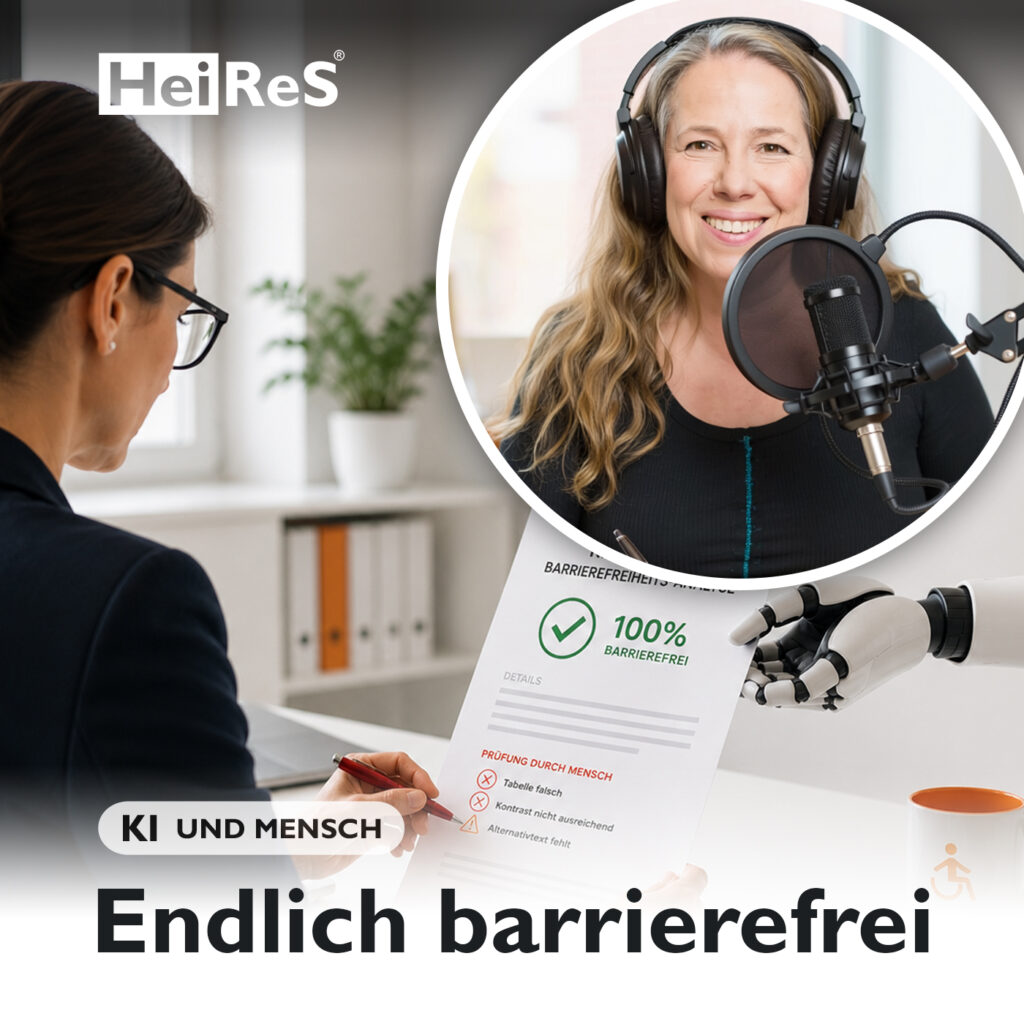
20 Kilometers for Digital Inclusion: Our Summary of the Smart Country Convention and the New 2026 Study
Three intensive days at the trade fair, four packed exhibition halls at Messe Berlin, and well over 20 kilometers of walking across the digitalization landscape of the public sector: That is the tally of our participation in the Smart Country Convention (SCCON) 2026.
For us at HeiReS and our non-profit IT hilft gGmbH, the trade fair was an absolute success. In over 80 personal conversations with representatives from cities, federal states, software providers, and the Ministry of Digital Affairs, we brought digital accessibility to where it legally and socially belongs: right to the top of the agenda for government and administration. Yet aside from the positive feedback at the fair, our newly published study shows that the path to an inclusive digital state is still a major construction site.
The 2026 Detailed Study: Unique Methodology Combining AI and Humans
The focus of our exhibition presence was our largest societal mammoth task to date: The 2026 detailed study on digital accessibility in Germany. In contrast to purely superficial, automated scans, we subjected the core web offerings of 84 major German cities (based on the Bitkom Smart City Index) and, for the first time, all 16 federal states to an in-depth stress test.
What is special about our methodology is the consistent dual perspective:
- AI-assisted preliminary check: Our custom-developed AI models analyze websites with high efficiency across large data sets along established standards.
- Manual expert review: To correct AI context errors, certified specialists (IAAP) as well as individuals affected by barriers manually evaluate the findings.
- The 112-point check: Every portal was rigorously tested against 100 official BITV criteria as well as 12 specific inclusion questions from the perspective of those affected.
The Hard Facts: Where Does Germany Stand at the End of 2026?
The overall conclusion of our study is a true wake-up call. The majority of all examined websites remain only 40 to 65 percent accessible even at the end of 2026. As a result, numerous municipalities and federal states fall significantly short of the legal requirements set by the German Disability Equality Act (BGG) and the Online Access Act (OZG). They inadvertently exclude people with disabilities from participating in municipal and state life.
Focus on Federal States: Between Pioneers and Laggards
For the first time, we analyzed the central state portals of all 16 federal states. Massive differences in quality emerged:
- The top trio: A huge compliment goes to Baden-Württemberg (1st place with a proud 89.5% accessibility!), closely followed by Bremen (79.5%) and Saarland (78.75%). They prove that accessibility is achievable through clean code and strategic planning.
- The need for action: While our home state of Saxony sits in a solid 9th place in the midfield, the bottom dwellers of the table slip below the 65 percent mark. Because each federal state operates under its own legislation and editorial teams, our detailed analyses break down the barriers on a state-specific basis.
From Results to Implementation: Our Tools for Your Success
Because it is not enough for us to simply point out shortcomings, we deliver the concrete tools needed to sustainably dismantle barriers in source code. In doing so, we draw a clear line between our free inclusion initiative and our professional testing product:
- 100% free support for the examined regions
As part of our inclusion initiative, we are sending a highly detailed, 40-page audit with concrete findings and recommendations free of charge via mail and post upon request to all examined cities and states. In addition, a 10-page individual analysis including a roadmap for barrier remediation is available as a free PDF download for every examined region. The initial personal consultation meeting regarding implementation is also completely free of charge for municipalities. - Our product: The professional detailed analysis for 900 euros
Are you an agency, a company, or a municipality looking to thoroughly test additional portals, websites, intranets, or online shops outside the study? That is precisely why we developed our detailed analysis.
It offers the full quality of a professional audit while breaking through existing budget limits: For an absolute bargain price of just 900 euros, we finally make in-depth accessibility testing affordable for every smaller company and financially constrained municipality. Because inclusion must never fail due to a budget!
Next Step: Take Action Now!
The German IT industry association Bitkom has already positively acknowledged our study results. Now it is up to the decision-makers in authorities and companies to set the course. Do not wait for the next reprimand or the next law.
- For municipalities from the study: Claim your free, individual 10- or 40-page evaluation and let’s discuss the roadmap in a free consultation meeting.
- For all other web projects: Secure our 900-euro detailed analysis in audit quality to set up your site securely and accessibly.
Simply write us an email at beratung@heires.net or use our contact form. Let’s make the web accessible together!