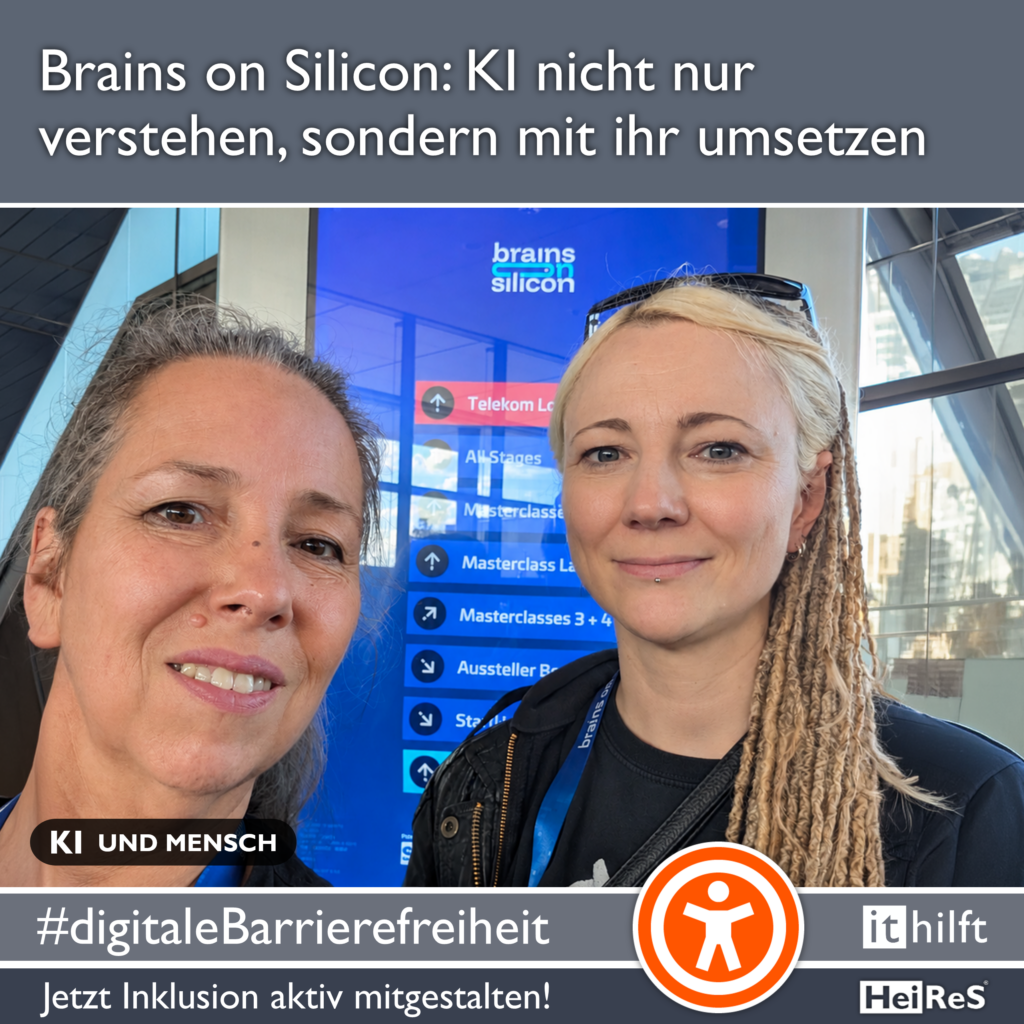
“Closing the Implementation Gap” was the motto of the Brains on Silicon AI conference in Dresden. And in a way, that sentence describes quite precisely why we from HeiReS were there: We have been dealing with AI for quite some time and primarily want to figure out how we can meaningfully integrate it into our daily work.
Accordingly, we went to the conference full of curiosity. And we returned home with a lot of new impressions, ideas, and also a few question marks.
From AI in Marketing to Vibecoding
Three topics were particularly exciting for us: AI in marketing, the workshop on vibecoding, and the question of how other companies are deploying AI meaningfully.
Vibecoding in particular kept us very busy. The idea of using AI to develop software without having to code every single step yourself opens up entirely new possibilities. For us as interface designers, what this development means for the collaboration between design, development, and AI is especially interesting.
Trying out prototypes faster, implementing ideas directly, or developing smaller applications—much of this could become significantly more straightforward in the future. At the same time, the question naturally arises as to where human expertise remains indispensable. Especially in UX, UI, and digital accessibility, it ultimately isn’t enough for something to just work technically. It has to be understandable, usable, and accessible.
Not Every Insight Needs to Be Directly Applicable
Even the presentations from which we couldn’t take away anything immediately applicable to our daily work were fascinating. Because that is precisely what made the conference so appealing to us: It wasn’t just about individual tools or concrete applications, but about the entire evolution of AI.
You got a sense of how rapidly possibilities are currently changing and how important it is not just to talk about AI, but to actually start trying things out and putting them into practice. This also brings us full circle to the conference motto: Closing the Implementation Gap.
And Then It Gets Pretty Big
To be honest, that flashed us a bit.
The dimensions heading our way over the coming years are currently difficult to grasp. Progress is accelerating ever faster, and what that ultimately means concretely for our work, our professions, and our everyday lives is something we can barely imagine today.
Therefore, we don’t have a single answer to that either. Of course, this speed is also a little intimidating. Nevertheless, we try primarily to see the opportunities and not let uncertainties slow us down.
Staying Curious and Trying It Out Yourself
What we take away from Brains on Silicon is therefore above all curiosity and the desire to experiment. We want to understand what is possible, where AI can meaningfully support us, and how we can concretely integrate it into our work at HeiReS without losing sight of our own expertise.
Perhaps we don’t need to know today what the working world of tomorrow looks like. But we can help shape it.
And that is precisely what „Closing the Implementation Gap“ is all about for us: Not just talking about what AI will be able to do someday, but figuring out what we can already do with it today.